10. Titan – Diameter: 5,510 kilometres / 3,200 miles
Titan, the second-biggest moon in the solar system, orbits Saturn, the second largest planet in the solar system, and is the tenth largest object in the solar system. Titan is special because it is the only moon in the Solar System with an atmosphere.

In order to capture photographs of its surface and look through it, a probe had to be sent there. Titan has lakes of liquid methane, as seen by images returned from the Huygens probe, which arrived in 2005, and radar data from the Cassini mission.
The element, which also exists as frozen methane on Titan’s surface and in its atmosphere, functions similarly to water on Earth. Sometimes, scientists compare Titan to an early Earth, and some even speculate that there may be life there.
9. Ganymede – Diameter: 5,262 kilometres / 3,270 miles
Ganymede, which orbits Jupiter, the largest planet in the solar system, is the largest moon in the solar system. It is large enough that it was discovered by Galileo Galilei in 1610 through one of the first telescopes.

It has areas that are extensively cratered, similar to many moons, and areas that are much smoother, indicating that a geological disruption took place after the period of intense pounding, probably from meteors. Deep below the surface, according to scientists, there might be water.
8. Mars – Diameter: 6,794 kilometres / 4,222 miles
The Red Planet has welcomed many visitors over the years, allowing rovers to drive across its surface, snap pictures, prod its rocks, and examine its soil. Mars is far more hospitable than Earth is. It’s still not a place you’d visit right away, though. Mars isn’t the finest spot for a day trip because of its unbreathable atmosphere, lack of water (okay, maybe a little bit), and extremely low temperatures. That does not mean that there is no possibility of life there. The possibility of life being on Mars continues to be supported by scientific data.

7. Venus – Diameter: 12,104 kilometres / 7,521 miles
Venus is frequently referred to as Earth’s somewhat smaller twin because of its similarity in size, mass, gravity, and composition, and is the 7th largest object in the Solar System.

Being 1 km below sea level on Earth is comparable to the surface pressure on Venus. Its temperature is almost 500 °C (900 °F), hot enough to melt lead, and its atmosphere and clouds both contain sulphuric acid.
A surprising fact about Venus is that a day on Venus is longer than its year and that it rotates in the other direction!
6. Earth – Diameter: 12,756 kilometres / 7,926 miles
The Solar System’s most distinctive, exceptional, and fascinating object is located at position six. It is Earth, the first solid-surfaced object and the first location you can actually stand.

Earth is the best habitat for life since it has water on its surface, a breathable atmosphere, a suitable climate, and protection from the Sun’s harmful radiation. Numerous living forms now inhabit the earth, and you are most likely one of them!
5. Neptune – Diameter: 49,532 kilometres / 30,779 miles
The fifth largest object in the solar system, Neptune, was the Solar System’s furthest planet at the time of its discovery in 1851. When Pluto was found in 1930, it lost its claim to this title, which it briefly regained in the late 1990s because of Pluto’s peculiar orbit. Neptune was once again designated as the Faraway Planet in the Solar System. The last of the Gas Giants, Neptune marks the end of the Solar System’s zone dominated by the enormous gassy giants.

4. Uranus – Diameter: 51,118 kilometres / 31,763 miles
The fairly uninteresting and featureless Uranus ranks fourth on our list of largest objects in the solar system. However, it makes up for its lack of beauty with oddity. Uranus tipped over at some point throughout its existence, possible due to colliding with another heavy object.

Whatever happened, Uranus now rotates around the Sun on its side. Because of its orbit, Uranus has a magnetic field that makes day and night last for 42 years, and its moons circle above and below the planet.
3. Saturn – Diameter: 120,536 kilometres / 74,900 miles
Saturn, Jupiter’s distant neighbour, is ranked third on this list of the Solar System’s large objects. Saturn, like Jupiter, is a gaseous planet with many moons in orbit that are of different sizes and shapes. Saturn has a diameter of 120,536 km (74,900 miles), but when its rings are taken into account, that diameter more than doubles to a whopping 270,000 km (168,000 miles).

2. Jupiter – Diameter: 142,984 kilometres / 88,846 miles
Jupiter, is the largest planet in the solar system and the first of the gas giants. Jupiter is referred to as a gas giant because it is primarily formed of gas (hydrogen and helium).

Although they are unsure, scientists speculate that it may contain a solid core encircled by liquid metallic oceans. Jupiter is a tumultuous planet, with The Great Red Spot in particular raging for at least three hundred years. Jupiter has at least 79 moons orbiting it.
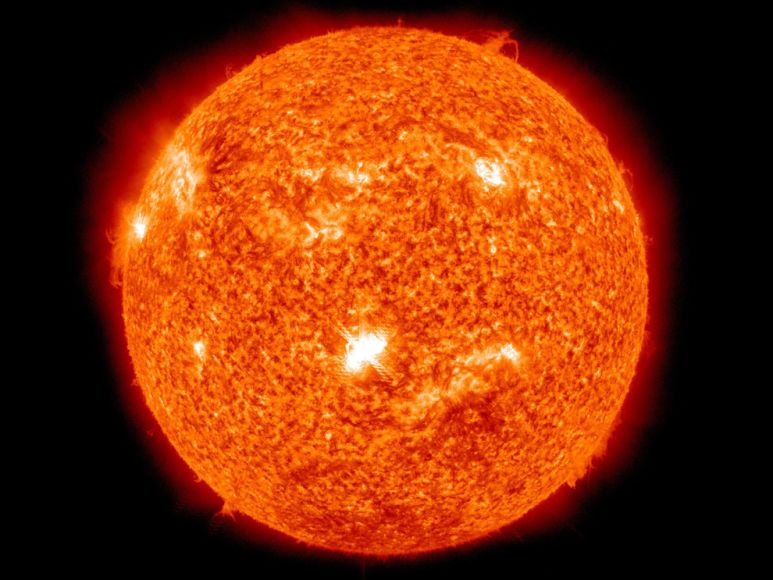
1. Sun – Diameter: 1,392,000 kilometres / 865,000 miles
The Sun, everyone’s favourite star is the indisputable holder of the title of official largest object in the Solar System. The Sun is enormous enough to hold every other object in the Solar System, with a breadth of 1,392,000 km (865,000 miles) and a mass of over 2 million million million million kg! As it ages, it will grow even bigger.

Leave a Reply